What Is the Problem? The Most Important Question in Military Planning
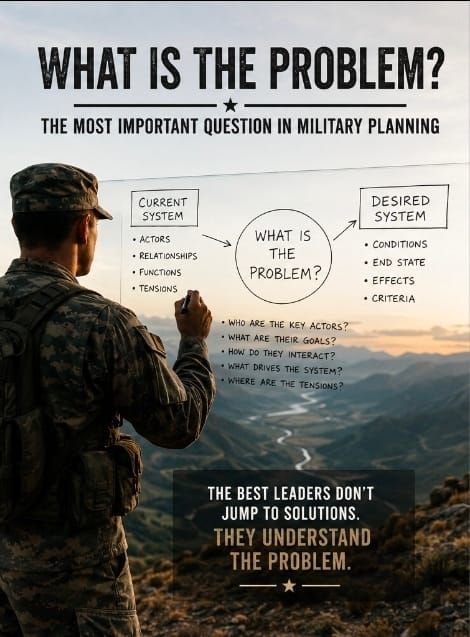
History is filled with brilliantly executed plans that solved the wrong problem.
Armies have trained harder, spent more money, bought more equipment, and deployed more people, only to discover that none of those actions addressed the issue that mattered most.
Execution rarely fails because soldiers lack effort. Execution fails because leaders misunderstood the problem they were trying to solve. Before a leader asks What should we do?, there is a more important question:
What is the problem?
Every planning methodology in the U.S. military, from a squad leader conducting Troop Leading Procedures to a combatant command using Joint Planning Process, ultimately revolves around this question. Some frameworks ask it directly. Others approach it indirectly. But they all recognize the same truth: if you define the problem incorrectly, every subsequent action becomes less effective.
The Army's Tradition of Problem Solving
The Army has never lacked planning methodologies. Troop Leading Procedures (TLPs) help small-unit leaders rapidly understand their mission and prepare their Soldiers for action. The Military Decision-Making Process (MDMP) provides a structured framework for staffs to analyze missions, develop and compare courses of action, and produce executable orders. Army Design Methodology (ADM) encourages commanders and planners to step back from immediate tasks and understand complex operational environments before converging on solutions. At the joint level, JP 5-0 integrates these ideas into a comprehensive planning process used across combatant commands.
These methods differ in scale and purpose, but they share a common foundation: understand the operational environment, identify the problem, and only then develop solutions.
The temptation is to treat planning as a checklist. Experienced staffs can become so proficient at the mechanics of MDMP that they rush toward course-of-action development before fully understanding the situation. Likewise, small-unit leaders can jump from receiving a mission directly to assigning tasks without pausing to question the assumptions embedded in the mission itself.
Doctrine is not merely a sequence of steps. It is a disciplined way of thinking. Every planning process begins by asking, implicitly or explicitly, "What problem are we actually trying to solve?"
The Danger of Jumping to Solutions
Organizations often confuse symptoms with problems. A unit performs poorly during a training exercise. Someone immediately says, "We need more training." Another responds, "We need more people." A third argues, "We need better equipment." Perhaps those are the answers, but they are guesses until the problem is understood.
Maybe the issue is not a lack of training but conflicting guidance. Maybe it is not a shortage of people but unclear priorities. Perhaps the equipment is adequate, yet the maintenance system is broken. Every premature solution narrows our thinking and blinds us to other possibilities. Complex military systems are composed of people, organizations, technologies, processes, and environments that constantly interact. Focusing on a single visible symptom often ignores the relationships that produce it. Good leaders resist the urge to prescribe before they diagnose.
Learning from Strategic Leaders
Some of the most effective modern commanders became known not because they possessed perfect answers, but because they continually refined their understanding of the problem.
General Stanley McChrystal describes in My Share of the Task and Team of Teams how the Joint Special Operations Command transformed itself during the wars in Iraq and Afghanistan. Rather than simply increasing operational tempo, the organization reframed the challenge. The problem was not that individual units lacked competence, it was that the enemy adapted faster than a traditionally structured organization could respond. Understanding that problem led to new approaches emphasizing shared consciousness, decentralized execution, and faster learning.
General Jim Mattis, in Call Sign Chaos, repeatedly stresses the importance of studying history, questioning assumptions, and developing judgment before acting. Throughout his career, he viewed professional reading not as an academic exercise but as preparation for recognizing patterns in unfamiliar situations. His decisions were informed by a habit of understanding context before prescribing action.
Risk management follows the same principle. Effective risk management is not about eliminating risk. It is about identifying the hazards that truly matter, understanding their causes, and deciding which risks are acceptable in pursuit of the mission. Poorly framed problems lead to poorly managed risks.
Strategic leaders understand that adaptation begins with perception. They devote significant energy to understanding the system before attempting to change it.
Practical Tools for Framing the Problem
Problem framing does not require elaborate diagrams. It requires disciplined observation.
Begin by asking:
What does the current system look like? Describe the environment as it exists today. Identify the actors, structures, and processes involved.
What should the desired system look like? Define success in concrete terms rather than vague aspirations.
Who are the key actors? Consider friendly forces, adversaries, partners, civilians, and institutions. Every actor has goals, capabilities, and constraints.
How do these actors relate to one another? Relationships often reveal leverage points that individual organizations cannot see.
What functions are producing current outcomes? Examine the activities and processes that sustain the present state.
Where are the tensions? Contradictions, competing priorities, resource constraints, and mismatched incentives frequently reveal the true sources of problems.
These questions encourage planners to see beyond isolated events and toward the underlying dynamics of the operational environment.
Becoming a Better Problem Understander
The military profession often celebrates decisive action. Action matters. Initiative matters. Speed matters. But none of those qualities compensate for solving the wrong problem.
The leaders who consistently outperform their peers are those who invest time in understanding before deciding. They ask better questions. They simplify complexity without oversimplifying reality. They define problems in ways their teams can understand, debate, and improve. The best leaders are not merely generators of solutions. They are students of systems.
They can define a problem clearly, explain it in plain language, and build shared understanding across an organization. Only then do they guide their teams toward measurable, achievable, and meaningful solutions that create lasting operational impact.
In the end, planning is not about producing the perfect order. It is about developing the right understanding. And the quality of every plan, every operation, and every decision begins with a single question:
What is the problem?

Comments ()