Articles
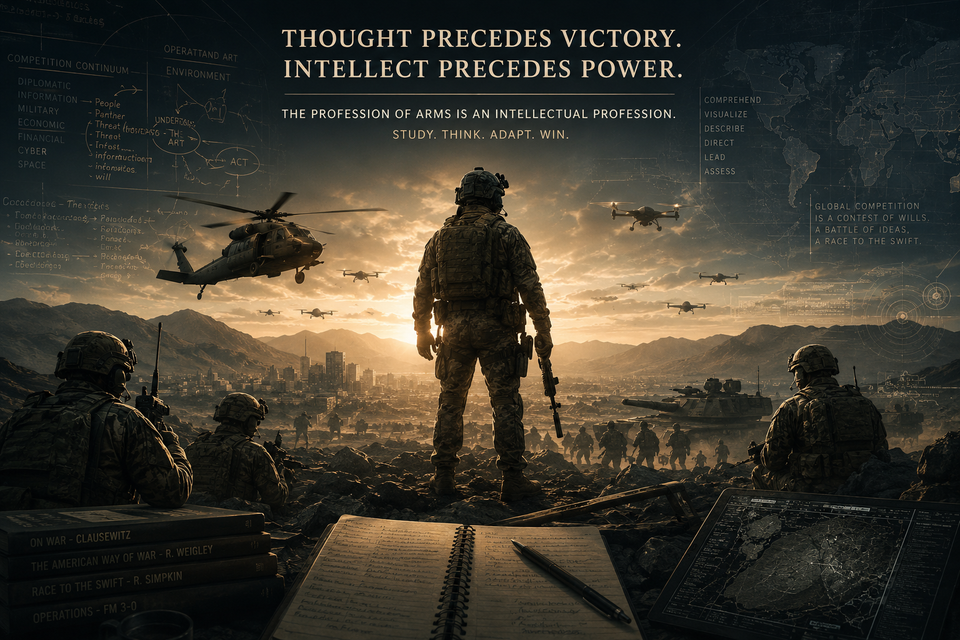
WHY THE PROFESSION OF ARMS IS AN INTELLECTUAL PROFESSION
"The object in war is a better state of peace."
— B.H. Liddell Hart
Most people believe the military is about physical strength.
They're wrong.
The profession of arms has never primarily belonged to the strongest, the fastest, or even the bravest. It belongs to those who can think.
Throughout history, nations that failed to adapt their thinking have paid for outdated ideas with blood. New technologies and weapons do matter, but history repeatedly shows that ideas about war change faster than institutions. Victory often belongs to those who recognize that change first.
Every generation of military professionals inherits a battlefield different from the one before it. The challenge is not simply to master today's doctrine. It is to prepare for tomorrow's war before it arrives.
That is why the profession of arms is, first and foremost, an intellectual profession.
Every war is a contest of ideas
Military history is often taught as a sequence of battles, campaigns, and famous commanders. It is better understood as the evolution of military thought.
The Greeks explored discipline and cohesion. Napoleon transformed operational maneuver and the concentration of force. Clausewitz explained war as a political instrument shaped by uncertainty, friction, and human will. The Industrial Revolution reshaped logistics, firepower, and mobilization. Recently, airpower, nuclear deterrence, information warfare, cyber operations, artificial intelligence, and autonomous systems force military professionals to rethink how wars are fought.
Weapons change.
Technology changes.
But more importantly, thinking changed.
The officers who study only doctrine become experts in yesterday's solutions. The officers who study military thought become prepared for tomorrow's problems.
The American way of war
Russell Weigley argued in The American Way of War that the United States gradually developed a distinctive approach to warfare. It is one emphasizing the destruction of enemy military power through overwhelming resources, decisive points, and tolerable risk management. Look no further than the current state of affairs in the Middle East as proof.
That approach helped win enormous victories in the twentieth century.
Yet Weigley's work is not simply a celebration of American success. It is also an invitation to examine whether the assumptions that produced past victories will produce future ones.
Today's adversaries understand America's strengths.
Many will seek to avoid them.
Rather than confronting American military power directly, they may attack our alliances, disrupt supply chains, manipulate information. Their objective is not always to destroy our armies. Sometimes it is to exhaust our will.
Military professionals cannot prepare for those challenges by studying only yesterday's battles.
They must understand how the character of war evolves.
The race never ends
Richard Simpkin described warfare as a continuous competition in Race to the Swift. Victory belongs, not simply to those with superior equipment, but to those who learn, adapt, and innovate faster than their opponents.
That observation is even more relevant today. Technological change no longer occurs over generations. It occurs over weeks. Artificial intelligence, autonomous systems, commercial satellites, cyber capabilities, precision strike, additive manufacturing, and inexpensive drones have compressed the timeline between innovation and battlefield application.
Military organizations that cannot learn quickly risk becoming obsolete before they realize they have fallen behind.
The race is no longer merely to the swift.
It is to the thoughtful.
The Military Intellectual
T. E. Lawrence understood that successful campaigns depended as much upon understanding people, culture, politics, and psychology as they did upon tactics. His observations remain valuable because he recognized that war extends beyond battlefields into the realm of ideas and legitimacy.
Modern military thinkers continue this tradition by exploring operational art, systems thinking, cognitive warfare, logistics, information advantage, and the integration of emerging technologies. They remind us that tactical excellence alone is insufficient. Success increasingly depends upon connecting military action to strategic objectives across multiple domains.
The profession demands leaders who are comfortable reading history, questioning assumptions, studying economics, understanding technology, and writing clearly enough to persuade others.
Thinking is not an academic luxury.
It is a military necessity.
Our responsibility
The United States does not choose the existence of adversaries.
It inherits them.
Every generation faces competitors and opponents seeking to challenge American security, influence, prosperity, or alliances. Some will attempt to defeat our armed forces directly. Others will seek to undermine our economy, our institutions, our partnerships, or our ability to project power abroad.
The geopolitical landscape shifts with remarkable speed.
Military professionals cannot afford intellectual complacency.
Our responsibility is not merely to execute today's missions. It is to anticipate tomorrow's conflicts before they emerge.
That requires disciplined reading.
Careful writing.
Historical understanding.
Critical thinking.
Professional debate.
Lifelong learning.
Welcome to The Military Intellectual
This website exists because I believe the profession deserves more than leadership slogans and motivational quotes.
It deserves serious thought.
Here, we'll study military history not to memorize battles but to sharpen judgment. We'll read great books not to accumulate knowledge but to cultivate wisdom. We'll examine leadership not as personality, but as professional practice. We'll explore logistics, operational art, strategy, technology, and the ideas shaping the future of warfare.
The profession of arms is entrusted with the defense of a nation.
That responsibility demands more than courage.
It demands minds equal to the challenges of an uncertain world.
The future battlefield is already taking shape.
The question is whether we are thinking deeply enough to meet it.