The Military Intellectual's Toolkit: The Tools Every Leader Should Carry
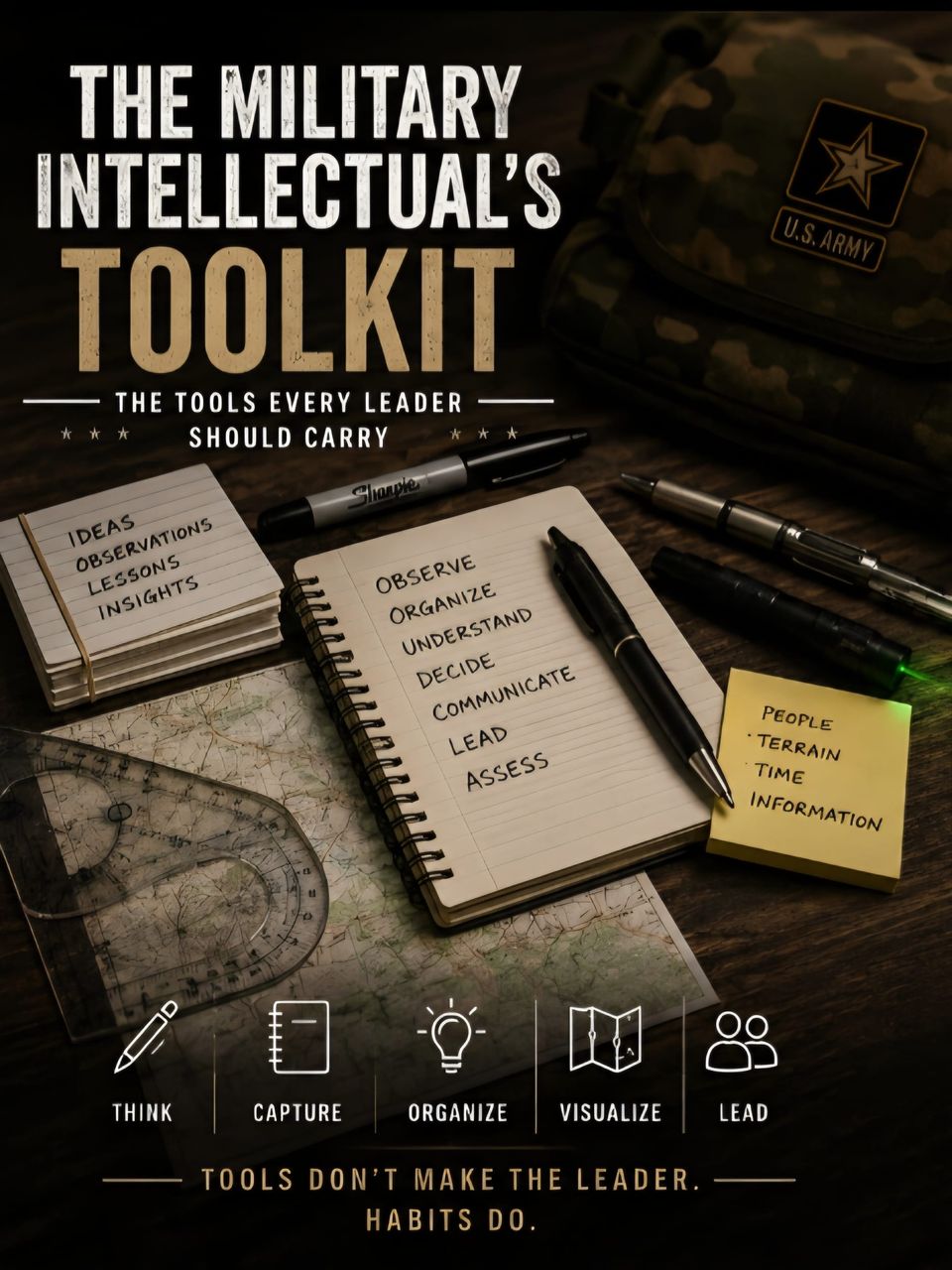
Every generation of soldiers has had its symbols. The Roman centurion carried his vine staff. Medieval knights wore swords that represented authority. George Washington carried a telescope. Ulysses S. Grant rarely traveled without cigars and maps. George S. Patton famously carried ivory-handled revolvers, but those pistols weren't what made him dangerous. His notebooks, maps, and relentless study did.
Throughout history, military leaders have carried tools, not because the tools themselves made them effective, but because they enabled better thinking.
Today's battlefield is different.
Instead of riding horseback across Europe, officers manage digital command posts, synchronize operations across continents, analyze satellite imagery, and make decisions while drowning in emails, Teams messages, PowerPoint slides, and endless meetings.
Information has become ammunition. Attention has become a scarce resource. Thinking is a competitive advantage. Yet despite this explosion of information, many leaders still arrive at work carrying little more than a multitool and a cellphone. They expect themselves to remember everything, organize everything mentally, and somehow become better planners through sheer effort.
That's not how great military thinkers have ever worked.
Dwight Eisenhower relied heavily on note cards, personal filing systems, and disciplined calendars. George C. Marshall obsessively organized information before making decisions. Modern commanders surround themselves with notebooks, whiteboards, digital planners, and staffs specifically designed to manage information.
The lesson is simple:
Great leaders build systems. Their tools extend their thinking.
Mission command depends on understanding, visualization, description, direction, leading, and assessment. Every one of those activities depends upon information being captured, organized, and communicated. A leader without tools is attempting mission command with unnecessary friction.
Your Physical Thinking Kit
Physical tools remain surprisingly powerful because they slow us down just enough to think clearly.
A Quality Pen
A pen is not simply something that writes. It is a thinking instrument.
Writing forces clarity. Drawing works out structure. When you cannot explain something on paper, you probably don't understand it well enough yet. Ideas become tangible when ink touches paper.
Buy one quality pen you enjoy carrying. It doesn't need to be expensive. It simply needs to encourage you to write. Multi-color pens are a fantastic touch. A tip is to use different ink colors to highlight specific functions. Green ink are ideas jotted from the words of the commander, blue ink is from any key staff member, black ink are specific internal thoughts. Red ink is something you need to understand better.
A Notebook: Your External Brain
Your brain was designed to have ideas, not store them forever. Every briefing, every conversation, every observation, every lesson learned...
Capture it.
Military leaders constantly receive fragments of information that later become significant. The notebook becomes your second brain. The best notebook is the one you consistently use.
Index Cards
Ideas rarely arrive at convenient moments. They happen in parking lots. During PT. Walking between meetings. Standing in formation. Index cards allow rapid capture of ideas before they disappear. They can even serve as quick talking points before you need to address a wide audience. Entire books have begun on index cards. So have operations.
Permanent Marker
This may seem oddly specific. Until you've needed to label equipment during a deployment. Marking containers or packages, sketch a plan for a group, signing certificates, identifying priorities on an MRE case. The permanent marker solves dozens of field problems that no laptop can.
Laser Pointer
Every leader briefs. The laser pointer forces deliberate communication. Instead of waving your hands across a terrain model, map, or slide, you direct attention exactly where it belongs. Good briefers move information. Great briefers move understanding.
Map Tools
Maps remain one of the military's greatest thinking tools. Carry map pens.
Grease pencils. Protractors. Scale rulers. Map overlays. Even in a digital world, commanders continue gathering around physical maps because they encourage collaboration differently than screens. You need to carry a map and force teammates to use their map. Create shared understanding through shared tools.
Sticky Notes
Sticky notes make ideas movable. Planning is iterative. Courses of action evolve. Priorities change. Sticky notes allow concepts to be reorganized without rewriting entire plans. Many design sessions are simply organized conversations using sticky notes.
Planner
A planner is a physical notebook meant to track daily to quarterly obligations. Utilizing this tool will help you see friction, track progress, and communicate priorities based on goals. The best planners help you capture daily obligations but help you see opportunities to accomplish long term objectives.
Your Digital Toolkit
The modern battlefield requires digital fluency. Technology should reduce cognitive load, not increase it.
OneNote
OneNote may be the most valuable productivity tool available to military professionals.
Store:
• doctrine
• meeting notes
• deployment lessons
• counseling templates
• planning checklists
• articles
• professional reading
• journals
Searchable knowledge compounds over time.
PowerPoint
PowerPoint receives endless criticism. Poor PowerPoint deserves criticism.
Good PowerPoint organizes thought. The best slides simplify complexity. Few words, more icons and pictures do the trick. If there needs to be more complexity imbed an excel. Think of PowerPoint as explaining something on a napkin. Simple visual to accompany a narrative. Creating excellent presentations forces leaders to clarify what truly matters.
Digital Calendar
Professional success often comes down to managing attention rather than managing time.
A digital shared calendar should contain:
• priorities
• maintenance
• higher HQs events
• PT
• commitments
• planning milestones
• down time
If it matters, schedule it.
Artificial Intelligence
AI is becoming another member of your staff.
Use it to:
• summarize doctrine
• compare concepts
• brainstorm ideas
• generate training scenarios
• improve writing
• challenge assumptions
AI does not replace military judgment. It accelerates learning. The military intellectual who ignores AI risks becoming the cavalry officer who ignored tanks.
Digital Reference Library
Build your own doctrine library.
Organize:
• Army/Joint publications
• long range training/planning calendars
• historical campaigns
• biographies
• articles
• powerpoints
Knowledge should be accessible in seconds.
Your Intellectual Toolkit
No physical tool matters without the habits to use it well.
Curiosity
Curious officers outperform merely knowledgeable officers.
Curiosity asks:
"What am I missing?"
"What would the enemy do?"
"What assumptions am I making?"
Humility
Humility allows learning an arrogance prevents it. The best leaders know they are often wrong before they know they are right.
Discipline
Ideas only become useful through consistent practice. Write often. Read and reflect daily. Small habits become advantages.
Ask "Why?"
Children ask "why?" naturally.
Military professionals often stop asking because rank rewards certainty. Never lose your curiosity. Every operation should begin with:
Why?
Mission Command Begins With Better Thinking
Mission command depends upon shared understanding. Shared understanding depends upon communication. Communication depends upon organized thinking. Organized thinking depends upon systems.
Your toolkit is not about buying expensive equipment. It is about removing friction between your ideas and your actions. The greatest weapon in modern warfare remains the human mind. Everything you carry should make that weapon sharper. Because your equipment does not make you a thinker. Your habits do.
Whether you are a platoon leader, commander, first sergeant, staff officer, or general officer, build a toolkit that strengthens your ability to understand, visualize, describe, direct, lead, and assess.
The Army invests billions of dollars into every warfighting function. Yet all of them ultimately depend on one function to synchronize them: command and control. Mission command succeeds only when leaders can think clearly, communicate effectively, and build shared understanding. The military intellectual recognizes that the most important piece of equipment isn't carried in a rucksack or mounted on a vehicle. It's the disciplined mind, supported by tools that transform ideas into action.

Comments ()