The Enforcer's Dilemma: Why Military Power Exists to Compel, Not Conquer
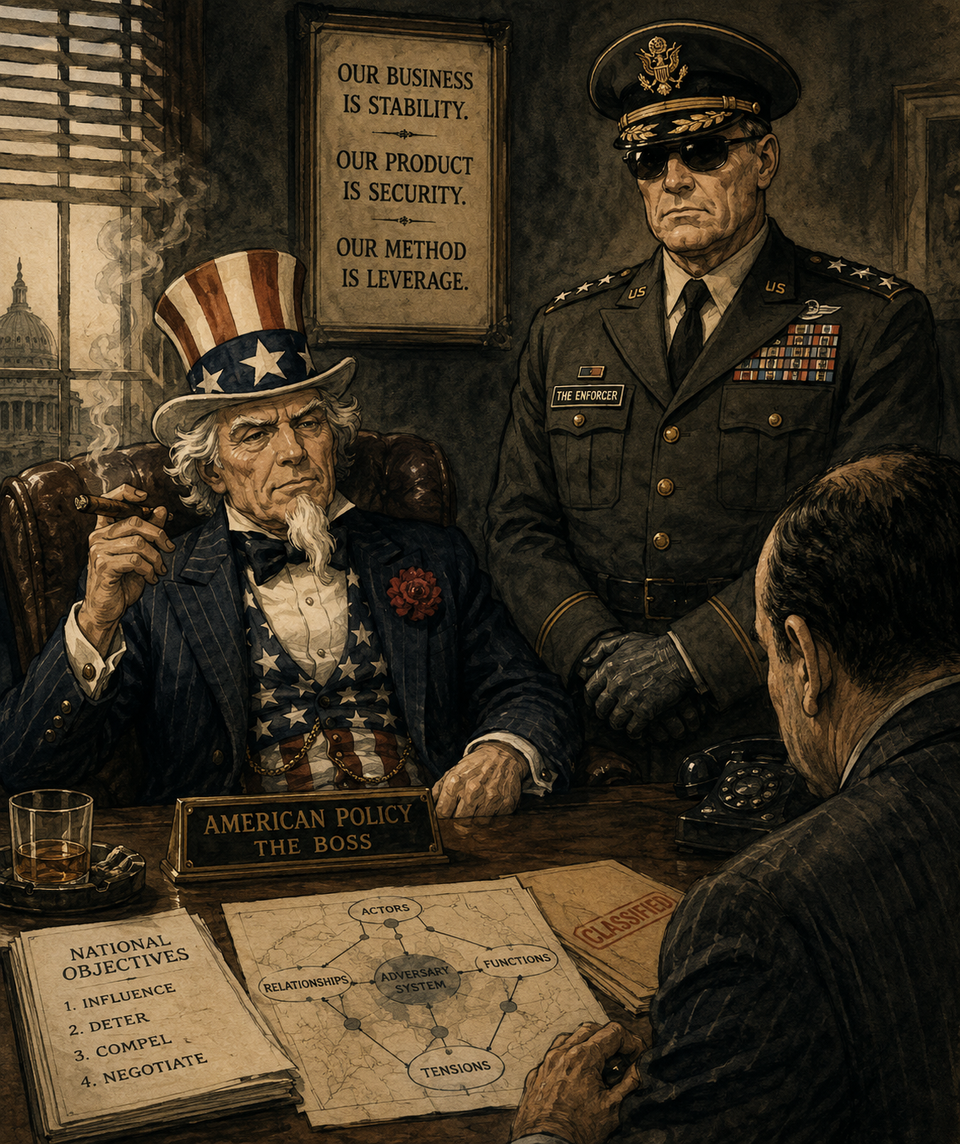
"Real victory in war is usually a matter of harnessing military violence to a political strategy that will normally require some kind of negotiated settlement to end the fighting." — Chris Kolenda, Zero Sum Victory
Imagine a Mafia boss discovers one of his debtors has stopped making payments.
He does not immediately order the debtor's execution. Instead, he sends an enforcer.
The enforcer's purpose is not to kill. It is to make the consequences of continued resistance unmistakably clear. If the debtor understands the message, the violence stops. Money begins flowing again. The organization achieves its objective.
A reckless enforcer who murders every debtor is not effective, it is counterproductive. Every dead debtor represents a failed business transaction, lost revenue, and unnecessary instability. Violence detached from strategy destroys the very objective it was intended to secure.
While morally worlds apart, this simple logic illustrates a truth about military strategy that American policymakers and military professionals have struggled to appreciate for decades: military force is not an end in itself. It is an instrument of political coercion.
Too often we judge military success by the destruction it inflicts rather than the political outcomes it produces.
That is a dangerous misunderstanding.
From Clausewitz to Weigley to Kolenda
Carl von Clausewitz famously observed that war is "the continuation of policy by other means." Although often quoted, the second half of that idea is frequently forgotten. If war exists to serve policy, then military operations cannot become detached from political objectives. Tactical victories that fail to produce favorable political conditions are, at best, incomplete successes.
Russell Weigley's The American Way of War argued that the United States developed a tradition of seeking decisive military victory through overwhelming force and the destruction of enemy armies. American history seemed to validate this approach. From the Civil War to the Second World War, victory often came through annihilating an opponent's capacity to resist.
That tradition shaped generations of American military thought.
Chris Kolenda's Zero Sum Victory does not reject Weigley as much as it exposes the limits of that tradition.
Against insurgencies, terrorist organizations, and other non-state actors, there is often no enemy capital to occupy, no government to surrender, and no army whose destruction automatically produces favorable political conditions. The pursuit of total military dominance can become strategically disconnected from the political objectives it was meant to serve.
As Kolenda argues:
"Real victory in war is usually a matter of harnessing military violence to a political strategy that will normally require some kind of negotiated settlement to end the fighting."
Military force remains indispensable.
But it is rarely sufficient.
We Measure the Wrong Thing
American officers naturally admire decisive operations. We plan campaigns, synchronize fires, integrate maneuver, and pursue operational reach. These are essential military competencies.
Yet planners should ask a more uncomfortable question:
What political decision do we expect our military actions to produce?
Destroying an enemy headquarters is not success if another immediately replaces it. Capturing terrain is not success if it has no political value. Killing enemy fighters is not success if recruitment outpaces attrition.
Military power should not be measured by the amount of destruction inflicted but by whether it changes an adversary's political calculus.
Violence is valuable only when it creates leverage.
History repeatedly reinforces this point. During Vietnam, the United States won countless tactical engagements while failing to produce the political conditions necessary for strategic success. Conversely, the 1962 Cuban Missile Crisis demonstrated that military power can achieve political objectives without large-scale combat because credible force altered an adversary's decision-making.
In both cases, the decisive factor was not destruction.
It was coercion.
The Purpose of the Enforcer
This distinction returns us to the Mafia analogy. The boss seeks profit, influence, and organizational survival. The enforcer exists to make the boss's demands credible. An enforcer who simply kills everyone misunderstands his purpose. Likewise, the American military does not exist to maximize destruction. It exists to make American national policy credible.
Military power should convince adversaries that continued resistance is more costly than capitulation. The ideal outcome is not endless combat but an opponent who concludes that negotiating with American policymakers is preferable to confronting the XVIII Airborne Corps, a Carrier Strike Group, or a Marine Expeditionary Force.
The objective is not to destroy every enemy.
The objective is to reshape the enemy's choices.
To Compel Begins with Understanding
This is where many operational planners encounter the real challenge.
You cannot compel an adversary if you do not understand what they value. Threatening something they are willing to lose produces little strategic leverage. As absurd as it sounds, breaking the kneecaps of someone who has no legs accomplishes nothing. The effectiveness of coercion depends entirely on understanding the system you intend to influence.
Every adversary operates within an interconnected political, military, economic, social, informational, and cultural system. Success depends less on identifying targets than on identifying pressure points. This requires a different mindset than traditional targeting.
It requires design.
Designing Coercion
Operational design offers planners a framework for connecting military action to political outcomes.
Shimon Naveh argued that operational art requires understanding warfare as an adaptive system rather than a collection of isolated tactical problems. Military organizations should resist the temptation to view campaigns as linear sequences of objectives and instead seek to understand the relationships that give an adversary resilience.
One useful framework begins by identifying four elements:
- Actors: Who possesses influence within the system?
- Relationships: How do those actors depend upon one another?
- Functions: What critical activities allow the system to survive?
- Tensions: Where do competing interests create opportunities for leverage?
These questions shift planning away from simply asking, What can we destroy? and toward asking, What must change for the adversary to alter its behavior?
Centers of gravity become more than physical headquarters or military formations. Critical vulnerabilities become more than targets on a synchronization matrix. They become opportunities to influence decision-making.
Systems thinking encourages planners to view military force as one component of a broader coercive strategy integrating diplomacy, economic pressure, information operations, alliances, and credible military capability. Military action creates pressure, but policy determines the direction in which that pressure should move an adversary.
Without that connection, operational brilliance risks producing strategic irrelevance.
Rethinking the American Way of War
Perhaps the next evolution of the American way of war is not abandoning decisive military power but redefining its purpose. The United States possesses the most capable military in history. The challenge for today's joint planners is not simply determining how to employ that power. It is understanding how to employ it in ways that produce favorable political outcomes.
Military power is not an independent instrument. It is the enforcer of national policy.
Our campaigns should therefore be judged not by how much we destroy but by whether they compel adversaries to conclude that cooperation is preferable to continued resistance.
The purpose of military power is not to destroy the enemy.
Its purpose is to convince the enemy that it is easier to deal with American policymakers than it is to deal with the American military.
That is not weakness.
That is strategy.

Comments ()