The Corsair Isn't the Story: Strategy Is
War has always accelerated innovation.
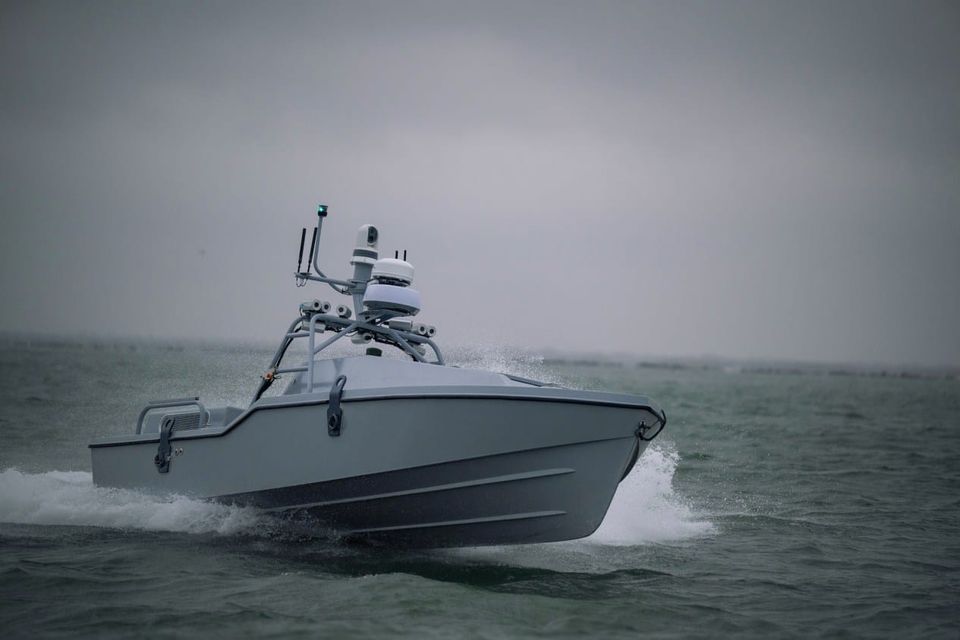
The machine gun, aircraft carrier, radar, precision-guided munitions, and unmanned aerial systems all moved from promising technologies to indispensable capabilities because conflict demanded rapid adaptation. The latest example may be found in the waters of the Middle East, where the United States has begun deploying autonomous surface vessels such as the Saronic Corsair.
On paper, the Saronic Corsair is impressive. At roughly 24 feet long, capable of traveling approximately 1,000 nautical miles, carrying payloads approaching 1,000 pounds, and costing less than many traditional naval systems, it represents a dramatic shift in the economics of maritime warfare. A commander can field multiple autonomous vessels for the cost of a single conventional patrol craft.
But impressive specifications are not strategy.
The real question is not whether the Corsair can operate autonomously. It is whether autonomous vessels help solve the strategic problem facing the United States in the Persian Gulf.
Too often, military organizations become fascinated by new technology before clearly defining the problem it is meant to solve. We celebrate range, speed, payload, and autonomy while neglecting the more important question:
What objective does this capability enable?
If the answer is merely "destroy Iranian submarines" or "conduct maritime surveillance," then the Corsair risks becoming another impressive tactical capability searching for an operational purpose.
The center of gravity in any potential confrontation with Iran is not its fleet of submarines. It is Iran's ability to threaten the free flow of commerce through the Strait of Hormuz.
Roughly one-fifth of the world's traded oil transits this narrow waterway. The strategic objective is therefore not simply to sink enemy vessels but to guarantee freedom of navigation. Success is measured by commercial shipping continuing to move safely through the strait.
This is where autonomous surface vessels become far more interesting.
Imagine dozens, or eventually hundreds, of relatively inexpensive autonomous craft continuously patrolling the shipping lanes, escorting merchant vessels, extending sensor coverage, sharing targeting data, and providing persistent maritime presence. Rather than concentrating on hunting submarines, they could help shape maritime traffic, monitor suspicious activity, and reinforce the southern shipping corridor adjacent to Oman, where commercial traffic already enjoys greater security.
Instead of treating autonomous vessels as expendable shooters, commanders could employ them as persistent instruments of sea control.
That distinction echoes one of the oldest debates in naval strategy.
Alfred Thayer Mahan argued that maritime power depended upon concentrating fleets to destroy an enemy navy and establish command of the sea. Julian Corbett offered a more nuanced view. For Corbett, the objective was rarely destruction for its own sake. Naval power existed to control maritime lines of communications and enable national policy.
The Strait of Hormuz appears to validate Corbett's perspective.
The United States does not necessarily require the destruction of every Iranian naval asset to achieve its strategic objectives. It requires commercial shipping to continue moving despite Iranian attempts at coercion. Sea control, not fleet annihilation, is the operational objective.
Autonomous surface vessels may prove ideally suited to that mission.
Ironically, Ukraine may have already demonstrated this principle. Its maritime drones were not remarkable simply because they destroyed Russian ships. Their greatest achievement was strategic. They challenged Russian control of the Black Sea, threatened logistics connecting Crimea to mainland Russia, and demonstrated that a conventionally weaker military power could impose operational dilemmas on a superior fleet. The drones mattered because they advanced strategic aims, not because they were technologically novel.
The Corsair deserves to be judged by the same standard.
Its success should not be measured by the number of submarines it detects or missiles it launches. It should be measured by whether it enables the United States to maintain maritime freedom of movement, reassure allies, complicate Iranian decision-making, and preserve stability in one of the world's most important chokepoints.
Perhaps today's deployment is simply a proof of concept. If so, that may be its greatest value. Every revolutionary capability begins as an experiment before doctrine, organization, and strategy catch up.
History suggests that war rarely rewards the nation with the most advanced technology. It rewards the nation that most effectively connects technology to strategy.
The Corsair is not the story.
The story is whether the United States can develop a theory of maritime warfare in which autonomous systems do more than replace existing platforms. They must change how sea control is achieved.
That is the real innovation worth watching. It may be needed elsewhere against a more powerful adversary.

Comments ()